Mercoledì 16 settembre Diego Carli arriva a Piumazzo per una serata della Rassegna Mensile degli Schizzacervelli: una selezione di cortometraggi horror presentata dal regista e, a seguire, Il caso Anna Mancini, il suo lungometraggio found footage del 2016.
L’appuntamento recupera la serata inizialmente prevista in estate e porta a La Grotta un autore che ha attraversato teatro, arti visive, recitazione, didattica e produzione audiovisiva prima e durante il proprio percorso nel cinema di genere. È una traiettoria particolarmente adatta allo spirito della rassegna: non soltanto proiettare film, ma mettere il pubblico a contatto con chi li realizza e con i processi, spesso ostinati e artigianali, che tengono vivo il cinema horror indipendente.
DAL TEATRO ALL’IMMAGINE
Il curriculum di Diego Carli è difficilmente riducibile alla sola regia. La sua formazione parte dalle arti visive e dal teatro, passa attraverso esperienze di teatro fisico, recitazione e spettacolo dal vivo e arriva progressivamente al video, alla regia e al montaggio. Negli anni Carli ha lavorato come attore, autore, regista e docente, mantenendo una continuità fra pratica scenica e costruzione dell’immagine.
Nel cinema horror questa natura trasversale emerge in una filmografia che comprende Orçe (2008), Il caso Anna Mancini (2016), Mommy (2019), Two Sisters (2022), Monitus (2024) e I Found You (2025), oltre ad altri lavori brevi e produzioni indipendenti. I Found You, per esempio, è un corto di poco più di sette minuti costruito attorno a due ragazze, una villa abbandonata e un giocattolo che trasforma il nascondino in un incubo.
IL CASO ANNA MANCINI: IL FOUND FOOTAGE SI SPOSTA NELL’EST VERONESE
Il centro della serata sarà Il caso Anna Mancini, horror italiano del 2016 della durata di 72 minuti. Carli sceglie la grammatica del found footage: ciò che vediamo assume la forma di un’indagine ricostruita attraverso materiali audiovisivi, registrazioni e immagini apparentemente recuperate.
La vicenda segue un giornalista e il suo operatore video mentre indagano sulla scomparsa di una ragazza e su un incidente che, nello stesso giorno, coinvolge un suo compagno di scuola. La ricerca apre progressivamente una fenditura su possessioni, riti antichi e presenze demoniache. Ma il dettaglio che rende il film particolarmente riconoscibile è il luogo: l’orrore non viene importato da un altrove generico, ma fatto emergere dal territorio dell’Est Veronese, trasformando paesaggio, cronaca e superstizione in parti della stessa costruzione narrativa.
Il film ha circolato nel circuito del cinema fantastico e indipendente: nel 2016 fu programmato, fra l’altro, al ToHorror Film Festival nella sezione dedicata al cinema ultra-indipendente italiano.
PRIMA DEL LUNGOMETRAGGIO: UNA SELEZIONE DI CORTI
La prima parte della serata sarà dedicata a una selezione di cortometraggi horror presentata direttamente da Diego Carli. Non anticipiamo qui i titoli: la scelta e la presentazione fanno parte dell’incontro con il regista. È anche il modo più corretto per leggere una filmografia che negli ultimi anni ha continuato a lavorare molto sulla forma breve, passando dall’orrore domestico alle streghe, dal rapporto con il paesaggio alla paura costruita attorno agli oggetti e agli spazi quotidiani.
Il punto, insomma, non è costruire una retrospettiva esaustiva, ma osservare da vicino come uno stesso autore affronti durate, mezzi produttivi e registri differenti, fino alla struttura più lunga e pseudo-documentaria de Il caso Anna Mancini.
DIEGO CARLI — RASSEGNA MENSILE
Mercoledì 16 settembre 2026 · ore 21:00 Pub La Grotta · Via dei Mille 197 · Piumazzo, Castelfranco Emilia (MO) Ingresso gratuito
In programma: selezione di cortometraggi horror presentata da Diego Carli + Il caso Anna Mancini.
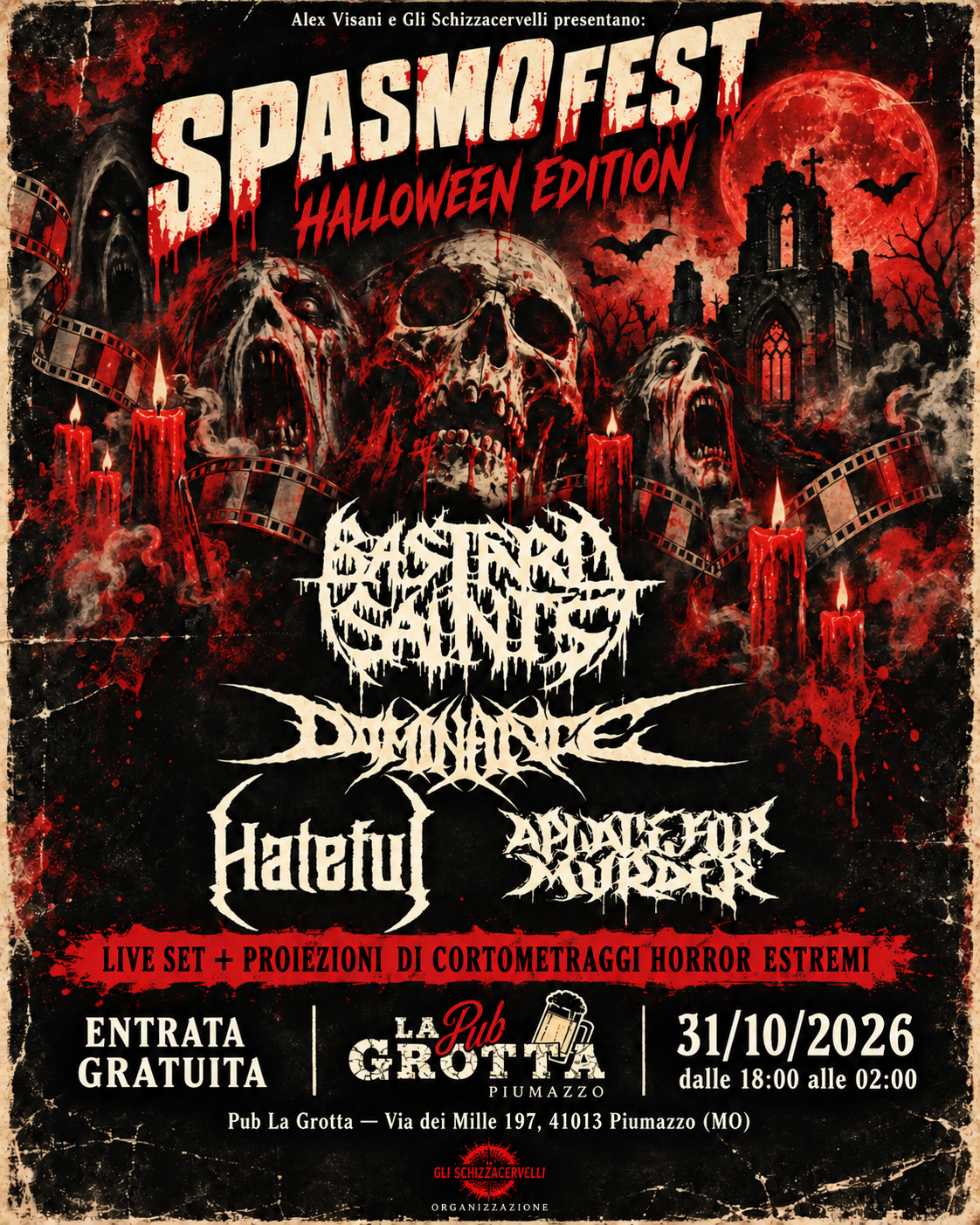
Spasmo comes to La Grotta on Halloween night. On Saturday, October 31, 2026, Gli Schizzacervelli host the Modena best-of of Spasmo, the horror festival directed by Alex Visani. The Piumazzo event is not one of the numbered competitive editions: it brings a selection of shorts chosen from the festival circuit to a live audience for one special night.
The programme combines four death metal live sets — Dominance, Bastard Saints, A Place for Murder and Hateful — with a selection of international horror short films screened throughout the evening. Doors open at 17:00, the programme runs from 18:00 to 02:00, and entry is free.
Timetable, selected shorts, travel information, parking, food & drink details and further updates will be published on the official event page.
I really don’t understand people who complain about bands being “formulaic”. Of course they are. That’s the whole point in listening to Death and Black Metal these days. It’s always been.
Think about the gym. You start lifting weights, you throw punches at a sandbag, you are not looking for a different experience every single time you go there to unleash your rage. You want the same movement, the same resistance, the same impact. You want something familiar that does its job. Being familiar with something that is supposed to release your energy is part of what this whole thing is about.
And when I say “the whole thing,” I mean every reflection of extreme metal that actually matters. Black metal, when it works, operates in mystical and esoteric terms: atmosphere, symbols, that sense of stepping into a ritual space where the same old elements are there for a reason. You’re “in the zone”, as you pump blood and breathe in and out. Death metal and Grindcore tend to operate on a similarly destructive pattern in their physical display of rage, the “body” music side of it, the part that pummels and churns. There are nearby genres that share blood with these, and plenty of little mutations and local dialects. But the core is the same. Different alphabet, similar goals.
People talk about “evolving” as if it’s some sort of moral duty. As if the genre owes anyone novelty. As if repetition is a defect rather than the mechanism.
Not really my point of view on this. Must be I live this music in a visceral way. Even if I wear glasses now, it doesn’t mean I am some sort of old school critic. This is, in my opinion, a genre built on recognizable shapes because those shapes are the point itself. They’re the conduit, the trigger that lets you switch the brain off and turn the engine on. That’s why any of us can listen to ten records that share a skeleton and still feel something real. The skeleton IS the tool.
The Grammar Holds: Mannerism, Metal, and the Myth of Novelty
I say it. Mannerism is king. And I mean that in the full art-historical sense. Mannerism is what happens when a tradition has fully matured: the grammar is so well established that the interesting work shifts from what to how. You’re not inventing the form anymore, we have plenty of bands that crashed against this wall in the mid ’90s.
You’re inflecting it. Every gesture becomes about refinement, exaggeration, stylization within a known framework. Pontormo and Rosso Fiorentino weren’t rejecting the Renaissance. They were fluent enough in it to twist it, and the twist was only legible because the foundation was shared. That’s precisely the space extreme metal occupies now, and has occupied for decades. The riff vocabulary, the production aesthetics, the structural logic all of it is codified enough that the real artistry is in the execution: the weight, the angle, the small choices that separate a record that genuinely hits from one that merely goes through the motions.
It also reframes what originality even means in this context. In a Mannerist framework, originality is mastery expressed as personal signature. Which is actually a far more demanding standard than novelty, because you can’t hide behind the shock of the new: the execution becomes everything. And this is where modern music journalism often loses the plot.
A lot of it, especially the safe kind, the shitty big portals, big glossy publications, condescending toward music in a very specific way. It wants to grab everyone’s attention at once, so it overpraises anything that can be sold as “experimentation,” as if experimentation itself were a virtue that automatically upgrades the art. But the deeper problem isn’t that they just value novelty. Or at least what their search engines perceive as such.
They don’t have the vocabulary to evaluate craft within a tradition.
A critic who genuinely knew the genre could tell you why one so call formulaic or “mannerist” death metal record hits harder than another doing the exact same things, small variations of perception one just cannot come up with if they don’t get it. They default to novelty as a proxy for quality because it’s the only axis they actually understand. That, and checking lyrics and symbolism for trigger warning some current sensibility.
The journalistic bias toward experimentation is, at its core, a bias against Mannerism, against the idea that working within and refining a tradition can be just as serious, just as artistically meaningful, as breaking from it. Which is a historically illiterate position, but here we are.
In extreme metal (and more or less related), band does experiment but still works, it’s almost always because they haven’t actually abandoned the skeleton, they’ve just dressed it differently. The moment a band genuinely steps outside the grammar, the reaction is usually not excitement but disorientation, and not the good kind. The ritual has been interrupted rather than varied. One can certainly write a new language. Art is meant to upset and disturb in any way conventional or not. But one in a million makes it.
Might be worth mentioning that for some reason, cool journalists also often indulge a glaring double standard worth naming. “Formulaic” gets weaponized against extreme metal by people who’d never apply the same word to the blues, where repetition and formula are essentially sacred. The twelve bar structure, the bends, the call-and-response are treated as tradition worthy of reverence. The bias reveals itself pretty cleanly there.
The genre lives on repetition, energy, destruction, discipline, horror. The same outlet, because that outlet is what people came here for in the first place.
When someone says a band is formulaic, that “they all sound the same”, my first reaction is still the same: of course it is. That’s why it works.
Liber XI Larvarum Qlippoth — The Anatomical Deconstruction of YHWH
Today marks the beginning of a document in the old sense of the word: something meant to record a process as it happens, so that when it is finished, there is a trace of how it came to be. I want this concept to be part of an old school “web log”.
Liturgia Necrotica Corticarum is the new demo by my project Necroblastoma. What follows will be an attempt to map its construction from the inside: the conceptual architecture, the musical decisions, the symbolic framework, and the work with gematria and Qlippothic correspondences that form the spine of the whole thing.
What This Is
Liturgia is a full-length concept album structured as a ritual in three phases, each corresponding to a Kabbalistic process:
Shevirat HaKelimThe Breaking of the Vessels (Tracks 1–4)
P’gamThe Permanent Wound (Tracks 5–7)
Hit’avorutThe Emergence (Tracks 8–11)
The conceptual engine is the Qlippoth or the infamous (in our “scene”) shadow side of the Sefirothic Tree of Life in Jewish mystical tradition. Each of the eleven tracks is assigned to one of the eleven Qlippothic shells (the corrupted counterpart of each Sephirah, sometimes intepreted as failed attempt at harmonic climbing to the pinnacle of creation), and each one is also mapped to a specific organ or anatomical system. The body becomes the Tree. Decomposition becomes theology.
The twelfth piece, Chaos Primordialis, is the dissolution back into the Ain or the pre-creational void that precedes even the first divine emanation. In this case, YWHH decomposes and corrupts into pre-creation nothingness. Goregrind pathology applied to anti-creationist Chaos theory.
Woven between the main tracks are eleven interludes based on corrupted Gregorian chant or Kyrie, Agnus Dei, Dies Irae, Libera Me, Sanctus, Requiem; each one more deformed than the last, following the path from relative purity (Interludes I–IV) through evident corruption (V–VII) into total disintegration (VIII–XI).
The Framework: Qlippoth, Anatomy, and the Deconstruction of YHWH
The central conceit of Liturgia is that the divine name YHWH understood here not as an object of devotion but as a structural diagram can be anatomically deconstructed. Each letter of the Tetragrammaton corresponds to a world (olam), each world to a level of being, and each level of being to a part of the body. The Qlippoth are what remain when the vessels shatter: the husks, the larvae, the corrupted residue of a creation that failed.
The eleven Qlippothic entities addressed across the album are:
Track
Qlippha
Corrupted Sephirah
Organ
1
Lilith-Nehemoth
Malkuth
Skin, connective tissue
2
Gamaliel
Yesod
Genitals, pituitary gland
3
Samael
Hod
Brain, cerebral cortex
4
A’arab Zaraq
Netzach
Heart, myocardium
5
Thagirion
Tiferet
Mediastinum, solar plexus
6
Golachab
Geburah
Immune system, spleen
7
Gha’agsheblah
Chesed
Liver, hepatobiliary system
8
Da’ath
(the Abyss or non Sephirah)
Throat, glottis
9
Sathariel
Binah
Uterus, ovaries
10
Ghagiel
Chokmah
Testes, Leydig cells
11
Thaumiel
Kether
Skull, superior cortex
Da’ath occupies the pivotal position at Track 8 or the hidden non-Sephirah, the Abyss between the lower and upper triads, the point of crossing. Musically this is the moment of total collapse: no structure, four simultaneous vocal tracks, deliberate rhythmic disintegration, and ten seconds of absolute silence at the center. Everything before Da’ath is breaking apart. Everything after is the emergence of something else.
Purification and ascendancy through putrefaction and postmortem fermentation.
The Conceptual Debt: Qlippothic Theosophy and the MLO Framework
One of the less obvious but more structurally important influences on Liturgia is the relatively modern approach of the Misanthropic Luciferian Order or Temple of the Black Light specifically their approach to Qlippothic pathworking as outlined in texts like Liber Azerate and the broader Temple of the Black Light corpus. The MLO framework treats the Qlippoth not as mere “evil shadows” of the Sephiroth but as autonomous anti-cosmic forces as the “black flames” that preexist and will outlast creation. Their eleven-shell system, their insistence on the Qlippoth as primary rather than derivative, and their ritual approach to each shell as a distinct initiatory threshold are all structurally present in Liturgia and reinterpreted as pathological processes.
The crucial divergence and the conceptual move that defines this album is the substitution of demonic entities with pathologies. Where the MLO summons Thaumiel as a force of cosmic division, Liturgia summons craniopagus, bifurcated aneurysm, split cortex. Where Golachab is the burning sphere of martial destruction, here it is cytokine storm, autoimmune cascade, the body incinerating itself from within. The demonic is not rejected but relocated inside the soma. Disease becomes the authentic face of the Qlippha. The body is not a vessel that demons inhabit; the body, decomposing according to its own internal logic, is the demonic process.
This reframing has a precise theological implication: it removes any possibility of externalization. There is no entity to invoke and dismiss. The Qlippha of Samael is prion disease as it is already inside you, it is rewriting your proteins, it is converting your own tissue into a hostile architecture. The horror is endogenous.
I won’t hide here most of these topics are not new to me but toying with these concepts certainly are but I really like the way some corrispndence between the cosmos certainly makes sense. Indulging on medical records is impossibly complex at times so I am perfectly aware there is a HUGE amount of approximation in this work. Please take it as it is just a cool way to combine concepts in a wicked puzzle for the mind.
On Gematria and the Tetragrammaton
Before the numerological structure of the album itself, there is the primary object of study: YHWH, the Tetragrammaton.
The gematric value of the four letters is well-established: Yod = 10, Heh = 5, Vav = 6, Heh = 5. Total: 26. 26 = 2×13, and 13 is the value of both Ahavah or love) and Echad (or unity) the name encodes the unity of love as its arithmetic foundation. This is the orthodox reading.
The Qlippothic reading inverts the operation. Rather than summing the letters toward unity, Liturgia is interested in expanding the name through full spelling (Milui) and then decomposing each expansion:
Yod spelled out: 20
Heh spelled out: 10
Vav spelled out: 13
Heh spelled out: 10
Total Milui: 53 — the value of Gan (garden) and also of Aven (iniquity, vanity, sorrow). The name contains its own corruption in the expansion. Disharmony as the source of malady.
Further: the four letters of YHWH correspond to the Four Worlds of Kabbalistic cosmology (Atziluth, Beriah, Yetzirah, Assiah), each world to a body of the divine, and each body to an anatomical register of the human form. Yod/Atziluth = the head and brain; Heh/Beriah = the chest and heart; Vav/Yetzirah = the torso and viscera; Heh/Assiah = the lower body and extremities. The album’s anatomical mapping follows this vertical axis beginning with skin and genitals (Malkuth/Assiah, the lowest world) and ascending toward the skull and cortex (Kether/Atziluth) but in reverse and in a state of progressive putrefaction. The divine name is read from bottom to top, decomposing as it rises.
The Temurah (letter permutation) of YHWH through the Atbash cipher where Aleph substitutes for Tav, Bet for Shin, and so on yields MTZPTZ, a name used in certain traditions as a demonic counterpart to the Tetragrammaton. This substituted name, its phonetic texture, and its gematric value (300) equal to the letter Shin, fire, the Holy Spirit, and simultaneously the Qlippha of primal combustion will appear in the textual layer of the album at specific structural moments. More on this in the dedicated post on the textual system.
Structural Numerology
The number 11 is not accidental, and the structural choices of the album are not arbitrary. In Kabbalistic tradition, 11 is the number of the Qlippoth the eleven shells that lie beneath the ten Sephiroth plus Da’ath. It is also the number of excess: one beyond the complete ten, the digit of transgression and rupture.
The album contains 11 main tracks + 1 dissolution piece + 11 interludes = 23 total pieces. 2+3 = 5, the number of the pentagram, the human body with arms extended.
The interludes are assigned to the 22 Paths of the Tree (specifically Paths 32 down to 12, moving upward from Malkuth toward Kether, but in their Qlippothic inversions). This structural mapping will be explored in depth in a future post dedicated entirely to the Path correspondences and their musical implications.
The working title Corticarum (genitive plural of cortex or bark, rind, shell, crust) was chosen because it contains within it three layers of meaning that are all relevant: biological (the cortex of organs, especially the cerebral cortex), botanical (the bark that surrounds living wood the husk), and architectural (the outer shell that must be shed for what is inside to emerge). In gematria terms, the word also points toward concepts of concealment the outer layer that hides.
Musical Architecture: A First Overview
The sound of Liturgia is not static. It undergoes a deliberate degradation across its runtime. Of course, this is just a first draft as I am trying to explore the concept coding it into sound, how these concept translate from theory to practice, is yet to be seen. Internet offers a lot of tools but being myself completely incompetent as a musician all the heavy stuff relies on my friend Setfano’s shoulders. Here anyway is a preliminary analysis.
Phase I (Tracks 1–4) is goregrind at its most legible blast-heavy, raw, structured. Production is intentionally old-school: HM-2 style guitar tone a la Dead Infection, triggered but organic drums, layered vocals (simultaneously throughout, think Inhume). Tuning sits at A standard / Drop G#.
Phase II (Tracks 5–7) introduces doomy Disembowelment-like influences, slows progressively from ~140 BPM down toward 80, and thickens the low end. The tuning descends further (reaching Drop F# by Track 7). The bass becomes a physical presence rather than a rhythmic anchor.
Phase III (Tracks 8–11) operates in territory that is deliberately broken. Da’ath is produced “in the red” intentional clipping, sub-frequencies (20–40Hz) designed for physical discomfort, no standard tuning. After the crossing, Tracks 9–11 each inhabit their own sonic universe: glacial reverb and “stone” textures (9), thin and deliberately castrated production (10), extreme stereo split with two guitars in tritone opposition (11) or abusive use of Diabolus in Musica.
The Gregorian interludes follow a parallel corruption arc beginning as relatively pure a cappella chant with cathedral reverb, ending as four simultaneous vocal layers in different time signatures, meters, languages, and pitch relationships, some of them reversed.
What Comes Next
Across subsequent posts in this series, I’ll be going deeper into:
The gematria study behind individual track titles and Qlippothic names
The Path correspondences of each interludio and their astrological/elemental attributions
The musical decisions for each track in detail (tuning rationale, structural choices, sampling sources)
The recording process as it unfolds session notes, problems, solutions
The textual layer the Latin/Enochian/Hebrew/glossolalia system and how the linguistic corruption progresses (see below)
SHEVIRAT HAKELIM INCIPIT.
LARVAE EMERGUNT.
The Language Layer: Archaeolinguistic Regression
There is a third axis of dissolution running through Liturgia, parallel to the anatomical and the Qlippothic: the regression of language itself.
In Kabbalistic cosmogony, language is not a human tool applied to a pre-existing world it is the medium of creation. The Sefer Yetzirah opens with the premise that God created the universe through the 22 letters of the Hebrew alphabet, through number, and through sound. The divine name YHWH is not a label for God; it is a structural formula, an operative sequence of phonemes that sustains existence by being. To dismantle language, then, is not a poetic gesture it is a cosmological one. It is the reversal of creation at the level of its operative medium. Liturgia proposes that the Qlippothic dissolution of the body and the archaeolinguistic dissolution of speech are the same process, approached from two directions simultaneously.
The regression follows the Semitic linguistic family backward through its own history from living liturgical language toward the pre-verbal substrate that precedes meaning entirely.
Stage I — Biblical Hebrew and Ecclesiastical Latin represent the outer shell: languages still in use, still structured, still capable of carrying theological content. But both are already, in a precise sense, dead as native tongues. Ecclesiastical Latin is a preserved corpse grammatically intact, phonologically fixed, severed from any living community of speakers. Biblical Hebrew, as used in liturgy, is similarly frozen in a classical stratum that no native speaker has inhabited for millennia. The album begins here because this is the skin of language: recognizable, intact, already dying. The liturgical texts of the interludes and the Latin invocations of the early tracks operate at this level.
Stage II — Classical Hebrew to Proto-Semitic marks the point where morphology begins to strip away. Biblical Hebrew already tends toward its root system — the three-consonant shoresh that underlies most words, carrying a semantic field rather than a fixed meaning, inflected into specific words by patterns of vowels and affixes layered on top. Moving back toward Proto-Semitic (the reconstructed common ancestor of Hebrew, Arabic, Aramaic, Akkadian, and the other Semitic languages, spoken roughly 5000–6000 years ago) means moving toward a language we know only as consonantal architecture. Proto-Semitic is not attested in writing. It is inferred from comparison across its daughter languages, and what emerges is a system of roots and phonological rules without the vowel pointing, without the morphological elaborations, without the syntactic flesh. What remains is skeleton: the bare consonantal infrastructure of meaning. This is the stratum of Tracks 3 and 4, where sibilants multiply and morphology collapses, where words start sounding like the roots they came from rather than the words they became.
Stage III — Proto-Semitic to pre-writing: the consonantal abjad and its dissolution takes the regression further. The earliest Semitic writing systems or Proto-Sinaitic (c. 1850 BCE), the ancestor of the Phoenician alphabet and therefore of Hebrew, Arabic, and Greek scripts were pure consonantal abjads: no vowels, no matres lectionis, no diacritics. A written word was a sequence of consonants that a reader had to animate with breath from memory and context. The word existed as potential, requiring a living speaker to complete it. This structural feature meaning as latency, requiring biological intervention to actualize is directly relevant to the concept of Ghagiel (Track 10), the Qlippha of potential that never manifests. The abjad is a language that cannot speak itself.
Stage IV — Glossolalia as the threshold is where the Semitic regression meets the abyss of Da’ath. Glossolalia is not just blasphemic random noise linguists who have studied it (notably William Samarin, in Tongues of Men and Angels, 1972) note that it faithfully reproduces the prosodic and syllabic structure of the speaker’s native language while replacing all semantic content with invented phoneme sequences. It sounds like language as it has rhythm, intonation, syllable structure but it refers to nothing. It is the formal shell of language without its content: exactly what the Qlippoth are to the Sephiroth, exactly what a husk is to the seed it once enclosed. At Da’ath, the album reaches this threshold. Below it, there is no language-shaped sound at all only the ten seconds of absolute silence at the center of Track 8, the void where even the form of speech dissolves.
Stage V — Pre-linguistic vocalization and infra-sound is the territory of Tracks 9–12: isolated phonemes detached from any system, the drone descending below 20Hz where sound becomes vibration indistinguishable from geological noise, and finally the Ain: not silence but infra-sound, the hum of matter before any mouth opened to name it.
The three axes of body, Qlippha, language converge at the same terminus: undifferentiated matter below the threshold of any organizing principle. Chaos Primordialis is what remains when the structures that produce drama have all dissolved.
Bibliography and Reference Texts
What follows is not a complete list but a working library of the texts that have been consulted, are being consulted, or will be consulted throughout the compositional process. Future posts will reference specific passages and arguments. Maybe.
Kabbalah and Jewish Mysticism — Primary Sources
Sefer ha-Zohar The foundational text of Jewish mysticism, 13th century, attributed to Shimon bar Yochai, compiled by Moses de León. The primary source for the doctrine of the Sephiroth, the structure of the divine name, and early Qlippothic theory.
Sefer Yetzirah The Book of Formation. The oldest Kabbalistic text, foundational for the correspondence between the 22 letters of the Hebrew alphabet and the 22 Paths of the Tree. Essential for the interludio path-mapping.
Sefer ha-Bahir The Book of Brilliance, 12th century. First systematic treatment of the Sephiroth and their correspondences.
Pardes Rimonim Moses Cordovero, 16th century. Systematic Kabbalistic encyclopedia, crucial for understanding the structure of the Sephiroth and their shadows.
Etz Chaim Isaac Luria (the Ari), compiled by Chaim Vital, 16th century. The Lurianic doctrine of Shevirat HaKelim (the Breaking of the Vessels) and Tikkun (restoration) is the direct theological source for Phase I of the album. The concept of divine sparks (Nitzotzot) trapped in the husks (Qlippoth) comes from here.
Kabbalah — Secondary and Academic Sources
Gershom ScholemKabbalah (1974, Keter Publishing). The essential scholarly overview. Scholem’s treatment of the Qlippoth as a theological problem within Jewish thought is indispensable.
Gershom ScholemMajor Trends in Jewish Mysticism (1941). Particularly the chapters on Lurianic Kabbalah.
Gershom ScholemOn the Mystical Shape of the Godhead (1991). Contains the most rigorous treatment of the demonic in Kabbalistic thought.
Moshe IdelKabbalah: New Perspectives (1988, Yale University Press). Useful corrective to Scholem, particularly on ecstatic and prophetic Kabbalah and its relationship to language and letter mysticism — relevant to the glossolalia system.
Elliot WolfsonThrough a Speculum That Shines (1994, Princeton University Press). On visionary experience and the body in Jewish mysticism.
Daniel AbramsThe Female Body of God in Kabbalistic Literature (2004). Relevant to the Binah/Sathariel section and the Lurianic feminine.
Qlippothic and Left-Hand Path Sources
Liber Azerate Frater Nemidial / Temple of the Black Light (MLO), 2002. The primary MLO text. Systematic anti-cosmic Qlippothic theology. The eleven-shell framework, the naming conventions (Thaumiel, Ghagiel, Sathariel, etc.), and the initiatory path through the Qlippoth are all drawn in part from here.
Qabalah, Qliphoth and Goetic Magic Thomas Karlsson, 2004 (Edda Publishing). A more structured and accessible treatment of the Qlippothic tree, with detailed attributions. Useful for cross-referencing the MLO system with broader Western occult tradition.
The Shadow Tarot Linda Falorio, 1998. Useful for the visual and symbolic language of the Tunnels of Set the qlippothic paths as described by Kenneth Grant.
Nightside of Eden Kenneth Grant, 1977 (Muller). Grant’s system of the Tunnels of Set and their Qlippothic correspondences. Not always rigorous but generative for symbolic thinking.
The Book of Smokeless Fire S. Ben Qayin, 2012. Jinn tradition as Qlippothic parallel relevant to the Arabic/Semitic demonic layer in the textual system.
Pathology and Medical Reference
Robbins & Cotran: Pathologic Basis of Disease Kumar, Abbas, Aster (various editions, Elsevier). The standard academic pathology textbook. Used as the primary reference for the anatomical and pathological accuracy of each track’s disease concept from autolysis and cadaveric spasm (Track 1) to prion disease (Track 3), cytokine storm (Track 6), and cirrhosis/ascites (Track 7).
Harrison’s Principles of Internal Medicine For clinical descriptions and symptom phenomenology used in the textual layer.
Linguistics and Language
Ferdinand de SaussureCours de linguistique générale (1916). The foundational text of structural linguistics. The concept of the phoneme as relational — existing only through difference from other phonemes — underpins the Stage IV analysis of consonantal abjads and isolated sound.
William SamarinTongues of Men and Angels (1972, Macmillan). The definitive linguistic study of glossolalia. Samarin’s observation that glossolalia faithfully reproduces the prosodic structure of the speaker’s native language while evacuating all semantic content is the precise definition operative at Da’ath.
Alice Faber Work on the reconstruction of Proto-Semitic phonology (various articles, 1980s–1990s). On the consonantal root system and the vowel-less infrastructure of proto-language relevant to Stage II and III of the regression.
John HuehnergardA Grammar of Akkadian (2005, Eisenbrauns) and comparative Semitic work. For the branching of the Semitic family from a common ancestor and the phonological changes that mark each divergence.
Peter T. Daniels & William Bright (eds.)The World’s Writing Systems (1996, Oxford University Press). On the development of abjad writing systems from Proto-Sinaitic onward the consonantal skeleton of language before vowels were systematically written.
Jacques DerridaDe la grammatologie (1967) and La voix et le phénomène (1967). The deconstruction of the speaking voice as self-present meaning. Directly relevant to the glossolalia of Da’ath: Derrida’s argument that speech is always already inhabited by the absence it tries to overcome.
Liturgy and Plainchant
Liber Usualis (1961 edition, Desclée). The complete collection of Gregorian chant. The primary source for all liturgical texts used in the interludes Kyrie, Agnus Dei, Dies Irae, Libera Me, Lux Aeterna, Sanctus, Requiem, De Profundis, Ave Maria, Benedictus, Credo.
The Oxford History of Western Music, Vol. 1 — Richard Taruskin. For the historical and structural context of plainchant as a musical system before its corruption in the interludes.
This list will be updated as the project develops. Specific citations will appear in subsequent posts as particular arguments are developed.
Tune in next week for the second installment of Mass Extermination Fest, this time featuring Supremative from Spain. “Spain” might be a bit too generic, since the band comes from the Canary Islands, where my well-off friends go to burn their bloody, utterly undeserved cash on the lifestyle they lead. But fine: in the end we like slaughter, and I doubt the band lives off rents from apartments leased to suckers.
Back to business: I’m guessing you want an opinion on the headliner, if you’re shortsighted enough to read this site and too lazy to do your own digging on Encyclopedia Metallum. I’ll tell you more: I think I’ll do a quick run-through of all the festival bands between now and next Saturday, so keep an eye on the new blog.
That three-color cover, which by now is basically the staple flag of that so-called bestial death subgenre cooked up at the start of the new millennium, already says almost everything worth knowing. Alessandro, the very young organizer of the fest, is a strong supporter of this stuff, and honestly it seems healthier than getting smashed into the ground on gin tonics in the Modena nightlife. We’re talking about that rotten strain of phlegmy, aspirated vocals that wheeze blasphemies over hammering, spiraling, hypnotic music. Some local names I won’t mention because it’s too obvious still pop into my head, like the famous Pink Elephant. I like this crap, obviously, as you already know. The album review is right below.
Barbarian is rawer than raw, abrasive metal from what I remember. I’ve seen him live a few times, and I’ve known these guys for longer than I’d like to admit. I remember their direction is more towards the primal energy of the first years of the genre than trying to go down the sink of systematic annihilation, but that is not a bad start.
Same goes for the awesome personal favorite that is Uraniavore Goatphago: more minimalistic than minimalist, completely undiluted cosmic chaos, basically a demi-glace reduction of Revenge concentrated right to the edge of recognizability.
Last, you might want to check out Dead Aeon Mist. He plays a genre that’s extremely hard to do properly without plunging into that easy, mass-market Swedish death metal sound. I heard some tracks in advance months ago, but I’m saving the final listen for the live show. I want a surprise.
But more than anything, next weekend I want to unplug from routine crap, so I’ll be drinking ethanol in various forms at the biker club where the show will be held. Come over and let’s talk gore, massacre, and demonic nihilism.
Things are going to feel and look awkward for some days. No worries dear putrefied readers, as I am just too lazy to work on the new layout in a safe environment. The stats are not impressive lately, and I am the one to blame, of course. But things will become clear on the go, as I will explain more of what I have in mind, starting with a complete new concept of how to handle this space.
This is going to stay the ultimate stop for the record label too so balancing content will be tricky. Alwas been, after all, but that’s the way we like it, isn’t it?
Jacques Collin de Plancy, Dictionnaire Infernal (1863)
I’ve always had a thing for BEHERIT. It was one of those bands that shaped my early, swampy, miasmic idea of Finland I had when I was a kid and was fully into this music. For me Finland was this sort of misty, mossy, otherworldly place. I remember talking about them a lot with my friend Marco, who passed away way too early at 38. We both were kind of fascinated with the figure Holocausto and his works, for some reason we also thought he was way younger than he actually was. We imagined him fully sleeve-tattooed at 14 or something, which wasn’t even far from the truth—he was maybe 17 or 18 in those old zine photos, which already felt like some kind of extreme statement in any case. In any case, never in my life I hoped to have the chance to see these guys live one day. Things like this have a special inner meaning, you know. I FEEL these shows, deeply.
Of course I am now talking about that 1990–1991 era, what people always lump into the “Blasphemy phase”, but honestly that label always felt too tight for what they were doing. Sure, the aesthetics lined up, the irregular facepaint and all, but Beherit were doing Black Metal in a way that wasn’t about screeches and raw riffs post “Black Mark”. It was more like… Tapping into some kind of ancestral rot. A psychic tunnel into the wrong kind of transcendence. That terrifying feeling you get when you stare into a mirror just a second too long.
For me Beherit was always Metal of Death, as their song goes, a Death that defies the “color” black. Black Metal not as absence of light, but as the color beyond space. They’ve always dragged me into this liminal zone half Aramaic sorcery, half pre-human dread. A place where natural forces aren’t gentle or harmonious, but feral and menacing. Go there check on their whole discography and find a common thread and you’ll get what I mean. It’s somehow ironic but totally fitting that “beherit” is a term that comes from syriac, an aramaic language adopted by early christians. Syriac for Satan, generally speaking, but what if we interpret Satan not as an entity but as a passage to somewhere else? This is what for me Beherit delivers.
Strip away the dogma, and a deeper, older archetype begins to surface. Beherit can be reinterpreted through a mythopoetic framework: not as an embodiment of evil, but as the threshold guardian, the necessary resistance that marks the boundary between the known and the unknown. Within a gnostic vision, this opposition becomes sacred — a gate, not a wall. Beherit does not destroy; he transforms. He is the keeper of the liminal space, the one who confronts the seeker with his own fear and desire. To face Beherit is to undergo a spiritual ordeal, a confrontation with the shadow self that leads not to damnation but to revelation. In this sense, Beherit is not a figure to be feared, but a symbol of initiatic passage, the dark mirror through which one must pass to awaken.
The show last night felt exactly like I hoped. I didn’t expect a precise setlist or a brutal chaotic black metal performance. I wanted that fog, those distorted signals behind the veil, the oniric, whispered flutes and diagonal distortions with exotic scents of middle east. Add to that the haze of time, it’s been 35 years, man, and I’m suddenly back in my parents’ basement, reading xeroxed fanzines listening to worn demo tapes until 3 a.m., showing up half-dead to school the next day .
Because, you know, back then, all these bands spoke to us only through their songs, poorly translated lyrics, occasional interviews in weird typewritten fonts. You rarely knew what anyone even looked like. With Beherit it was even more mysterious. Those bad photocopies with the fucked-up facepaint, this sense of being part of a bigger dance. We were Devil, we spoke all the languages of the world under one conscience.
That’s the thing. Whether it’s Engram or Electric Doom Synthesis or the new live tracks there’s always been a thread. You tune into it or you don’t. Beherit speaks many languages, but all of them bring to the other side. A gray, decaying, ritualistic realm filled with cracked terracotta statues sunburnt into oblivion and skeletal men with blind eyes that point at you in your dreams.
It’s like those shepherd dogs in the Caucasus, nobody gives a shit what color they are, or the shape of their snout. It’s all about temperament and how well they do the job. That’s how Holocausto operates. He speaks whatever language is needed to keep the gate of nanna alive. A gate that has never been about a specific language. Maybe I am kinda overreading it you never know, but I kinda feel his work has always been a bit misunderstood. This guy also disappeared completely from the “scene” for years, sprouting all kinds of rumors. Yesterday somehow all fitted into place and it was a satisfying feeling.
The Show
Anyway, yeah other bands played too. Crowd was packed. A bunch of people I’d only ever known online, and even more I hadn’t seen in 20+ years. Which makes sense. We’re all prostate check generation now.
Devoid of Thought probably stood out most for me—everything Caligari touches has at least something intriguing. Extirpation were visually cool, like a mix between Nifelheim and Ultra Silvam, and the music was solid, intricate even. But holy fuck, that voice. Just this high-pitched flat line, like a screech owl that nested in my haybarn these days. After two songs I had to leave the room. It hit me like nails on a chalkboard. Sorry dude, if I want shrieking noise I’ll throw on Yamatsuka Eye. Gorrch were better than I expected. Honest stuff. Still can’t get into Italian lyrics in this genre, but whatever. It worked.
All in all, a great day. Another check on the list of bands I thought I’d never see. And yeah, maybe the place was overstuffed, maybe half the crowd didn’t even know what they were witnessing. But even that made sense. The packed crowd, the way the band was barely visible through the blue smoke, silhouettes like Pazuzu in The Exorcist… it felt like spending an hour in the underworld, surrounded by drifting, disfigured souls. People will talk but I will treasure the experience.